How to Become a Chocolate Sommelier

In 2015, I discovered craft chocolate through the 37 Chocolates challenge. Over the course of 5 months, I reviewed 37 chocolate bars in honor of my 37th birthday that Halloween. I remember being enthralled by this world: the flavors! The makers! The people! When I posted my last review, I knew I’d stay involved in chocolate.

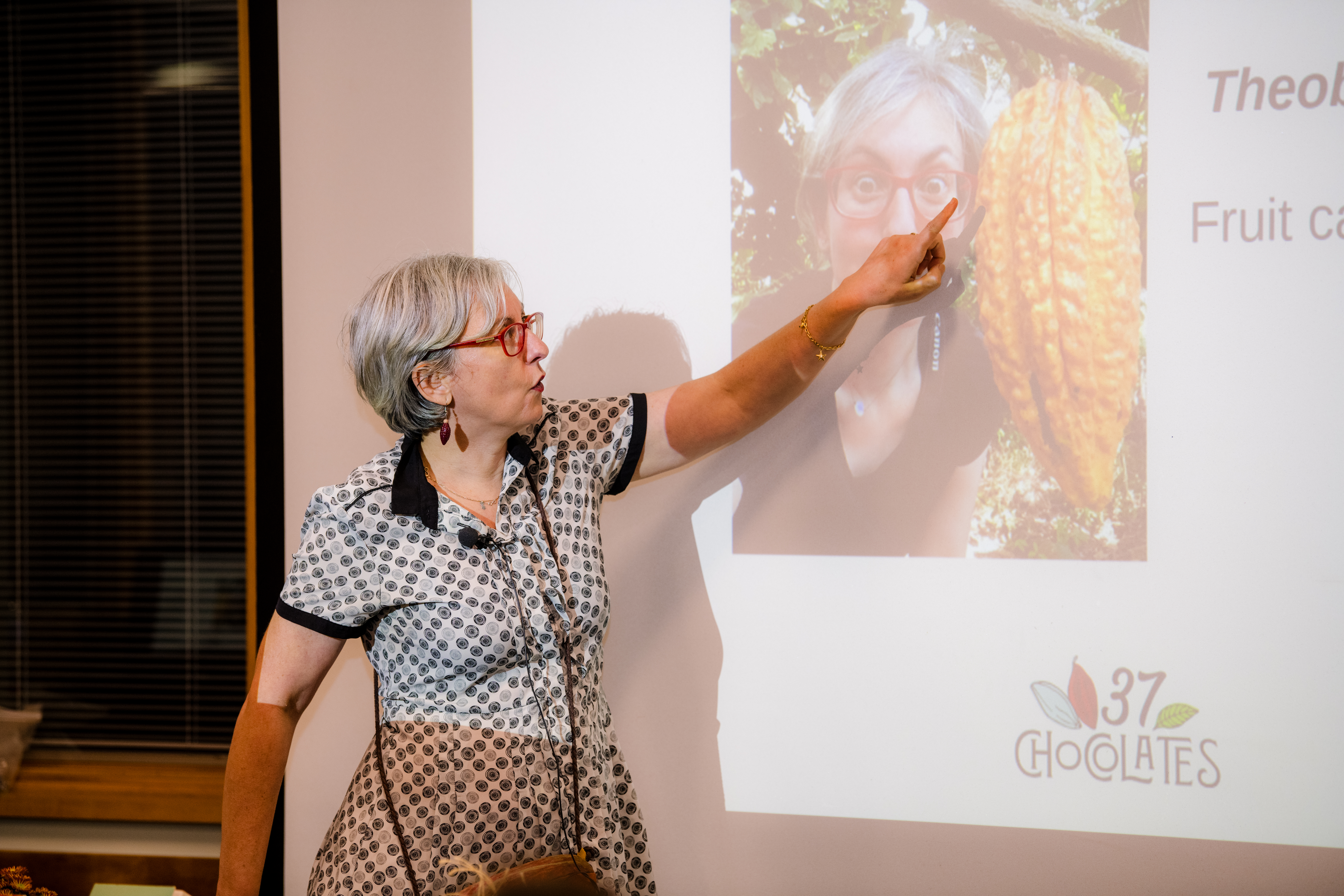
Today, I’m proud to share that I’m a full-time chocolate educator and experience provider (you can also call me a chocolate sommelier). Over the past decade, I’ve hosted hundreds of chocolate tastings & pairings and given dozens of talks about chocolate. Running a chocolate education business has made my world bigger. It introduced me to the world of wine, opened the doors of private clubs, and allowed me to travel all around the country.

Photo credit: Maura B. McConnell Photography

My path makes people curious. How did I learn about chocolate? How do I find clients? How do I structure an engaging talk? And how much do I charge for private events?

In this article, you’ll discover the steps you can take to become a chocolate educator or chocolate sommelier, so you can start generating an income, too. The journey isn’t quick or easy, but if you love chocolate and people, it will be gratifying.

Definitions

In this article, I’ll be using the terms “chocolate educator” and “chocolate sommelier” interchangeably. There’s currently no serious certification for “chocolate sommelier”, so check out this article to see how I define the term.

TL;DR: A chocolate sommelier is a hospitality professional who creates chocolate tasting experiences designed for connection.

This professional needs three skills:

  1. Subject matter expertise
  2. Relatability
  3. Turning chocolate knowledge into a business

If you’re passionate about chocolate, as I suspect you are, learning the subject matter will be the fun part. But turning your passion into a business requires two entirely different, yet essential skillsets. The third skill is the most essential to make it all happen because, as of 2026, self-employment is the most likely path to generate income as a chocolate educator. Let’s start with the subject matter expertise.

Photo credit: Maura B. McConnell Photography

1 – Learning About Chocolate

IICT Levels 1 and 2

The Institute of Cacao & Chocolate Institute (IICT) offers classes where you’ll learn about cacao and chocolate. A lot of my colleagues have a Level 2 certificate, and you can follow in their footsteps here.

I personally never took IICT classes because they weren’t available online when I started my chocolate journey. By the time the courses were offered online, my business was already off the ground. However, the colleagues and friends who have gone through their program highlight the alumni community as one of the best parts of the offering.

Good to know: while IICT certificates don’t offer a straight path to employment, they’re a prerequisite to becoming a chocolate judge. This isn’t a necessary step to becoming a chocolate educator and I chose a different path.

Ecole Chocolat’s “Mastering the Flavors of Chocolate” Online Class

This class, led by award-winning chocolatier Richard Tango-Lowy, will help you understand the origins of chocolate flavor.

A physicist by training, Rich is a phenomenal instructor who understands both the art and science of chocolate. I’ve run into him at chocolate festivals and conferences for years and, after a decade in chocolate, I still learn new things from him. During a phone call last year, he once mentioned how Ecuadorian cocoa butter is much firmer than other origins on the same latitude. Who knew? 

The online class is offered once a year, and the next session is scheduled June 19-July 17, 2026. You can get a discount if you use this link.

** This isn’t an affiliate link, and I receive no compensation if you decide to sign up**

Chocolate: From Commodity Crop to Ephemeral Luxury, an 8-week online course offered through Stanford Continuing Education

Taught by Dr. Carla Martin (Harvard University, ICCR) and José López Ganem (Boston University, ICCR), this class offers a deep dive into the history, culture, and marketing of chocolate. You’ll learn about chocolate’s Mesoamerican roots, its introduction to Spain, the unsavory history of the cacao and sugar trade, product certifications, representation in marketing, and so much more. Of course, you’ll also be tasting a LOT of chocolate.

I took the class in 2024, and it impacted the way I approach tastings, especially with international audiences. If you’re looking for a rigorous, academic course on chocolate, this course will be a game-changer. The 2026 schedule hasn’t been announced yet, but you can sign up for the 37 Chocolates newsletter to be notified of its next release.

** This isn’t an affiliate link, and I receive no compensation if you decide to sign up**

Chocolate Festivals & Industry Gatherings

From the moment I committed to living the chocolate life, I started attending one chocolate festival and one industry association gathering per year. 

From 2016 onwards, I thus went to the DC Chocolate Festival, first as a guest, then as a speaker, before testing other festivals, such as the Northwest Chocolate Festival in Seattle, the Dallas Chocolate Festival, and Salon du Chocolat in Paris. As the number of large chocolate events has grown over the years, I’ve remained focused on regional events in the mid-Atlantic area, which include:

For a list of 2026 festivals in the US, check out this Instagram post by @Chocochaser.

For years, I also attended the Fine Chocolate Industry Association’s yearly gatherings until my personal schedule started conflicting with the time of the yearly conference. More recently, I started going to the Philly Candy Show hosted by the Retail Confectioners’ Association of Philadelphia.

Attending these events allowed me to discover new craft chocolate companies, catch up with colleagues, make new friends, and, of course, learn about chocolate.

Not in the US? Steph of Beanstalkr does a great job listing upcoming chocolate events worldwide on her Instagram account.

At a wine & chocolate tasting at Casa Carmen Winery, February 2026

Additional Ways to Learn About Chocolate

Copywriting

In 2017, or two years into my chocolate journey, Catherine and Nathalie of Kosak in Paris, France, tasked me to write 200 product descriptions and 30 chocolate maker profiles (in both English and French) for their distribution catalog. To this day, I refer to this amazing learning opportunity as an unofficial “chocolate thesis”, as writing allowed me to process and absorb a huge amount of information on bean-to-bar chocolate.

Freelance Writing

Freelance writing can give you a great excuse to spend 2 hours with a chocolate-maker and learn about their work in exchange for a published article. Win-win.

Read the list of my published articles here.

Online Tastings

Getting ready for an online tasting

Virtual chocolate tastings are a fantastic way to learn about chocolate, while also connecting with like-minded people. And although nothing beats an in-person gathering, the online format is more inclusive to people with young children or living in remote areas. In other words, I’m a fan!

I regularly offer ticketed online chocolate tastings throughout the year, which are known to feature guest makers. Sign up for the 37 Chocolates newsletter to be notified of the next event.

Note that these tastings are for all levels of chocolate tasting experience.

Chocolate Subscription Boxes

When the 37 Chocolates challenge ended, I immediately subscribed to a monthly chocolate subscription box with Bar & Cocoa (formerly Chocorush). Each month for 2 years, I tasted 4 bars made by 4 makers from all over the world. The subscription played a big part in my chocolate education, and I highly recommend subscribing to a similar service if you’re new to bean-to-bar chocolate.

Popular subscription boxes include Bar & Cocoa, Cococlectic, Cocoa Runners in the UK (shipping worldwide), and The Chocolate Explorers, to name a few.

2 – RELATABILITY

An overlooked skill that you need to grow as you gain knowledge. Read my thoughts and advice on the topic here.

3 – MONETIZING YOUR CHOCOLATE KNOWLEDGE

At the beginning of my chocolate journey, hanging out with like-minded people at festivals and online felt like a relief. Finally, I’d found my people! But once I stepped outside that bubble, reality would sink in, and I had to accept that most people here in Chester County weren’t interested in paying to compare the difference between a 70% dark chocolate from Ghana and another from Peru. As a result, I had to change the format of my events to fill them.

Wine & Chocolate Pairings

Learning to pair wine & chocolate has been the single most important skill that helped me turn 37 Chocolates into a business. If you want to generate an income from chocolate tastings, you’ll probably need to learn it too.

Get started by downloading my FREE Beginner’s Guide to Pairing Wine & Chocolate. Don’t know a thing about wine? Well, I didn’t either. However, I’ve learned from partnering with wine industry professionals, and you can too.

The Recorded Video Course: Pitch, Design, and Lead a Chocolate Tasting

Since I’ve been documenting my journey for over a decade online, I’ve received a lot of questions on how to structure tastings. When I realized that many people struggled with editing their presentations, I created Pitch, Design, and Lead a Chocolate Tasting, a video course explaining my own process to create engaging presentations and calculate ticket costs. You can access the lesson here (cost: $67). Although several years old, the principles behind the videos are timeless.

Note that your purchase includes access to a Facebook group where you’ll connect with other chocolate educators around the world.

The Online Bootcamp: The Chocolate Educator Workshop

Screenshot of the first ever workshop cohort!

Some people watch the videos and go on to create their own successful programs. Others crave a more structured environment and accountability. For this second group, I created The Chocolate Educator Workshop, a small, supportive 4-week online program (limited to 6 people) designed to help chocolate lovers turn their passion into real bookings. I lead the sessions live on Zoom, and recordings are available for one month.

Here’s the program:

WEEK 1: Define Your Signature Offering & Market Position
WEEK 2: Client Research & Outreach Strategy
WEEK 3: Step-by-Step Breakdown of a 37 Chocolates Tasting (In-Person + Online) + Pricing Discussion
WEEK 4: Customer Experience & Growth Strategy

August session dates:

  • Tuesdays, August 4, 11, 18, and September 1, at 1 pm ET. You can sign up for the Tuesday sessions here. ** 5 spots left **
  • Thursdays, August 6, 13, 20, and September 3, at 4 pm ET. You can sign up for the Thursday sessions here. ** 3 spots left **

So far, we’ve had 30 participants across 9 countries, and what I hear again and again is how supportive the group feels. People share quotes, ideas, and small wins each week. It’s not just about learning from me — it’s about learning alongside others who are building something similar.

Below are testimonials from former students:

Ronee (my first star student!): 

David:

The Next Steps

Whether you’re a chocolate aficionado or an established chocolatier, you can tap into numerous resources to help you grow as a chocolate educator and experience provider. As your journey progresses, remember that practice is essential in building your skills and building your confidence as a chocolate educator. And if you need a little more coaching and guidance, send me an email to inquire about private consulting.

Relatibility is a Skill

Yours truly at a library. Photo credit: Maura B. McConnell Photography. Keep your slides simple!

There are two things you need as a chocolate educator: subject matter expertise and relatability.

If you’re drawn to chocolate, learning about the topic is easy. You taste a lot of chocolate and sign up for classes. You talk to chocolate-makers and attend chocolate festivals. One day, you’ll wake up and realize how much you know. Congratulations, you’re now a chocolate expert!

But if you want to pass that knowledge to a wider audience, building subject matter expertise isn’t enough — you also need to be relatable.

Relatability isn’t always recognized as a skill. But when your job is to get people excited about your work, you have to package your knowledge into relevant content. You need to edit your talks and make them more interesting than the phone in an attendee’s pocket. After all, the goal of a one-hour talk or 90-minute tasting is to spark curiosity, not turn the audience into scholars. So, how do you stretch that relatability muscle?

In Week 1 of the Chocolate Educator Workshop, I encourage attendees to sign up for a class on a topic they’re curious about, but not passionate about, such as a wine education or coffee cupping class. Tip: You can browse for events on the Eventbrite platform.

Next, pay attention to your experience. Did the speaker grab their attention? If so, how? Were there cool stories, videos, or props to keep you engaged? Be mindful of your experience and take notes. Ideally, you’ll repeat this quarterly throughout your career. This is important because as your knowledge grows, so will the gap between you and your audience.

Leading a chocolate tasting shouldn’t involve a lengthy monologue about “our passion”. Rather, it’s an opportunity to connect with our audience and get people excited about a surprisingly mysterious food. And that requires us to be relatable.

Yes, you should continue learning about your field. But as your knowledge grows, remember to stretch that relatability muscle too.

The Craft Chocolate Lover’s Guide to Paris

After years of tasting, interviewing, and writing, I’m THRILLED to introduce you to The Craft Chocolate-Lover’s Guide to Paris.

I wrote it specifically for bean-to-bar enthusiasts who want to experience Paris through the lens of craft chocolate. It’s hosted on the Saltete platform, which interfaces with Google, which means you can:

  • Explore suggested chocolate itineraries right on Google Maps
  • Find the nearest featured shop by clicking “See what’s near me.”

You’ll find:

  • 118 hand-picked addresses, including a comprehensive list of bean-to-bar makers in Paris and the surrounding areas. Also, my absolute favorite Parisian specialty coffee shop!
  • Detailed introductions for each chocolate company, including the name of the couverture suppliers for chocolatiers
  • Recommended products at each spot (chocolate sorbet, anyone?)
  • Four different itineraries
  • An FAQ with recommendations on the best times to travel and tips on navigating public transportation

It’s a personal guide to my favorite spots in the city. If you haven’t been to Paris yet, my tips will save hours of research. This means one thing: more time exploring the modern Parisian chocolate scene!

The guide has already been out for a couple of months, and I’m thrilled by the response so far. Here are some testimonials from early readers.

Reader Testimonials and Accolades

“The guide has the amazing gift of being written like it’s your very own personal guide to what you want to explore of Paris chocolate, whether it’s your first or 15th visit. It’s really something special.”

– Lauren

Chocolate sorbet at Plaq

“Hello Estelle, I used your Paris Chocolate Guide to plan my trip. I just got back home and wanted to say thank you again! I went to a few chocolate shops right away after check-in. I went to Dengo, Chapon, Jean-Paul Hevin, and oh my, that chocolate mousse from Chapon was amazing! They had a few flavors to choose from, even one for Christmas (I forgot the flavor), but I said no, I wanted to try the 100% Venezuelan chocolate recommended by you, that’s really amazing! Also, the hot chocolate from Dengo was the best. That was the first cup of hot chocolate I had in Paris, and it set the bar quite high, and that’s my favorite of the trip. I also chatted with the lovely lady at Dengo and shared with her how I found out about them through you. I also visited Jean-Paul Hevin, Rrraw, and PLAQ. They were all lovely. Thanks to you, I saved time on finding where to go for chocolate in Paris, and I have a very pleasant experience!”

– Mandy

Drinking wild Bolivian chocolate at Plein Coeur, a best-kept secret in Paris

For a deeper dive on the guide, check out Paris’s Best Chocolate Shops, Mapped in a New Digital Guide, the story that Anna Mindess’s wrote for The Chocolate Professor website.

I can’t wait to see how YOU will use the guide. Happy planning!

10 Years

Around this time 10 years ago, I was deep into the “37 chocolates” challenge. Over the course of 5 months, I reviewed 37 chocolate bars made in the US in honor of my 37th birthday on Halloween 2015.

I didn’t know it then, but this endeavor would change my life and career.

Yours truly with Chris Thompson and Laura Czarnecki of Philter Coffee. Originally published in Edible Philly magazine in 2016.

At the time, I’d just left a corporate job and had no idea what my next professional move would be. All I knew is I loved food, writing, and building community. I’d witnessed the burgeoning of the bean-to-bar movement and was curious about cacao origins. I remember going to Philter Coffee in Kennett Square and wondering what “Belize” or “Madagascar” meant in terms of flavor.

“If I eat the whole shelf,” I thought, “I’ll find out”.

And that’s exactly what I did.

Before I knew it, I was scouting the chocolate shelves of specialty food stores. When I ran out of sources locally, I started buying chocolate online.  didn’t fall in love with craft chocolate right away. In fact, it wasn’t until the 8th review (Acalli’s milk & nibs bar) that I knew I’d remain in this world forever.

It’s hard to summarize the following decade in one neat paragraph. All I can say is I now have a chocolate tasting & education business called 37 Chocolates.

This endeavor made my life richer, bigger, and oh-so delicious.

Visiting cacao farms in Colombia in 2019

Running a chocolate business opened the doors of some of the coolest places around, from cacao farms in Colombia to chocolate festivals in Dallas, DC, and San Francisco. It connected me to the wine and beer industries and allowed me to make the most wonderful friends.

Chocolate also got me through the doors of prestigious country clubs and allowed me to serve the president of an NFL team and the executive leadership of the ACLU.

With members of our lovely chocolate tasting club this past May.

It took a wild amount of work, patience, and persistence to get there. I had to have the faith that I was on the right path, despite staring at the financial evidence I may have been mistaken at times. But in the hardest days, I’ve always asked myself: “OK, what’s the alternative?” I never found an answer, so I kept going.

10 years ago, I chose to follow my curiosity. I stopped looking for someone to see some hidden talent in me and started mining for it myself. And that’s when the magic happened. Here’s to another magical, chocolate-filled decade.

Chocolate Stress

I like to stress my chocolate.

I’ll taste it on an empty stomach and after an espresso, early in the morning, and late in the evening, after a heavy meal, and right after a glass of wine.

Wait, doesn’t that go against every advice on how to taste?

Yup, and if you’re a colleague of mine, please resist the temptation to unfriend me.

Sure, in an ideal world, you’ll want to taste chocolate in a quiet, well-lit room, with no noise or strong smells. You’ll wait a couple of hours after a meal, then cleanse your palate between bites. This is fine for a chocolate industry professional, but for most people, this sounds like a chore.

When a client hires me for a private or virtual tasting, I have little control over the circumstances.

Some attendees will bring a mug of tea or coffee to the event.
Others will have finished a heavy meal.
One renegade will have finished the chocolate the day before the event and bring their notes to the tasting (true story).

In other words, people will do what they want hashtag #shocker.

When I realized that, I flipped the script on my tastings: I stopped expecting people to “do things right” and started adapting to their circumstances.

This is what that looks like:

When considering chocolate for my kits, I pick distinct bars with notes so different from each other than you could taste the difference even after finishing a bowl of curry.

Is the first bite dark and bold and fudgy? Great, then the second will be light and fruity.
Are we tasting a single-origin dark chocolate? Cool, then we’ll end with a milk chocolate.

When I choose chocolate for a client, I have one goal: to convey the amazingness of craft chocolate, no palate cleansing required.

What it means for chocolate to be accessible

When it comes to chocolate, many of my colleagues focus on making it “accessible” and by “accessible”, they mean financially affordable. But there’s another crucial type of accessibility: emotional accessibility.

Sure, a product can be affordable, but what if the sales environment feels exclusive? Or if a customer believes nice things aren’t for them?

Emotional accessibility IS important, especially when selling a luxury product like chocolate.

I learned that right before entering the workforce.

When I was 22, I interned at the coating lab of a car company based in France. The team was made up of 10 technicians, most of whom didn’t study beyond high school. Every year, it was the tradition for a supplier to take the team out for lunch. That summer, a sales rep took us all to a French Creole restaurant which had been awarded a Michelin star.

We were all very excited.

The whole dining experience was fantastic. We ate a three-course meal, which included a chicken dish served under an actual CLOCHE. It was also the only time in my life when I received a menu with no price (because, you know, women shouldn’t worry about how much things cost 😄).

None of us had the budget to justify this type of dining on our own. But when the opportunity for fancy dining was presented to us, we jumped on it.

In the US, people have a different relationship with food. When I share a piece of chocolate at pop-up events, some people hesitate before accepting, saying things like:

“I have basic taste in chocolate”.
“I don’t have a sophisticated palate”.
“I’m worried I won’t tell the difference”.

This makes me sad. When good food is offered to us, everyone should feel worthy of it.

And as a chocolate tasting host, it’s my job to create an environment that makes every guest feel like they belong. This type of accessibility is, in my opinion, at the center of discussions around hospitality. What do you think?

5 Chocolate-Makers You Need to Know

In 2022, I began writing for The Chocolate Professor website, and it’s been such a joy to share stories from the world of craft chocolate. My first article was a recap of the 2022 DC Chocolate Festival, and my most recent piece was a chocolate pairing guide inspired by Emily in Paris. But what I’ve loved most is writing about the incredible chocolate-makers whose bars I feature on the 37 Chocolates shop and at tastings.

These makers hold a special place in my heart— like Castronovo Chocolate, whose white chocolate with lemon & lemon sea salt is a revelation (don’t like white chocolate? That’s precisely why you should try it). Or Argencove in Nicaragua, whose bars are made straight at the source.

Each of these profiles allowed me to share more about the people and passion behind the bars you love. If you’ve enjoyed these products before, take a moment to read their stories and feel more connected to their thoughtful products.

Argencove Chocolate

Argencove Chocolate line-up at DC Chocolate Festival in 2022

A few years ago, I was inspired by a growing movement to support chocolate made at origin when I discovered Argencove, a company crafting award-winning chocolate in Nicaragua. There’s so much to love about Argencove, from their gorgeous, tile-inspired wrappers to their commitment to empowering women — most of their team is female.

But what sets their chocolate apart is the care they put into every bar. Take their Banana Clove bar, for example. Each tiny square is topped with perfectly sprinkled banana bits, so every square delivers a consistent, chewy, flavorful bite. I like pairing it with a glass of Sauvignon Blanc.

Must try bar: Argencove Banana Clove

Read Argencove Chocolate’s profile in The Chocolate Professor.

Castronovo Chocolate

Castronovo Chocolate’s legendary white chocolate with lemon & lemon sea salt

Castronovo Chocolate is the crown jewel of the 37 Chocolates collection. From the elegant packaging to the golden pouch that whispers luxury, every detail feels special. Of course, there’s the chocolate itself: smooth, creamy, and super silky. If you haven’t had Denise Castronovo’s white chocolate with lemon & lemon sea salt, you’re missing out.

Castronovo was one of the first chocolate-makers I partnered with, and over the years, that professional relationship has blossomed into a friendship. In 2019, I was fortunate to travel with Denise to Colombia on a cacao sourcing trip with Uncommon Cacao, which inspired my very first Zoom tasting.

If you’re ready to move beyond the white chocolate, give Denise’s 66% Arhuacos dark milk chocolate with nibs a try. The chocolate is bold, creamy, with a generous sprinkle of nibs.

Must-try bar: Castronovo Chocolate White Chocolate with Lemon & Lemon-Infused Sea Salt

Read Denise Castronovo Chocolate’s profile in The Chocolate Professor.

Cluizel Paris

Chocolate bonbons by Cluizel Paris

When I lived in France, I was only vaguely familiar with Cluizel Paris (then known as Michel Cluizel). Ironically, it wasn’t until I moved to the U.S. that I truly appreciated what a gem they are in the chocolate world. Founded just after World War II, this fourth-generation chocolate-maker was crafting bean-to-bar chocolate long before it became a trend.

Their bars never disappoint, and I admire their commitment to innovation. (Did you know they were the first to launch a 99% dark chocolate bar?) Today, they’re keeping things fresh with QR codes on their wrappers, offering an immersive tasting experience.

Can’t miss product: the selection of organic ganaches and pralinés (only available in Normandy and Paris)

Read the Cluizel Paris story in The Chocolate Professor.

Moka Origins

Jeff Abella and I in front of the Moka Origins factory store in Honesdale, PA

Moka Origins is like the girl next door of chocolate: approachable and dependable, but without trying too hard. The company’s based in Honesdale, Pennsylvania, right in the heart of the Poconos. Coincidentally, my mother-in-law lives less than an hour away from their factory shop, which means I get to drink their drinking chocolate twice a year.

What makes Moka Origins special is their double expertise: they’re both coffee roasters and chocolate-makers, as represented by their logo’s two coffee beans and two cacao pods. Their mission is rooted in supporting farmers, but CEO Jeff Abella understands that farmer support starts with building a strong, sustainable business. And trust me, the chocolate is good — like, very good.

The cherries on their cherry bar are plump and juicy. Their lemon ginger bar is made for cozy winter evenings. And if you’re ready to deepen your appreciation for chocolate, Moka Origins offers origin trips that are as educational as they are inspiring.

Must-try bar: Moka Origins 72% Ghana Dark Chocolate.

Read Moka Origins’s profile in The Chocolate Professor.

Qantu

Hidden Treasure by Qantu

I fell head over heels for Qantu’s chocolate while writing product descriptions for Kosak, a bean-to-bar shop in Paris. Their Gran Blanco bar left such an impression that I couldn’t help quoting French poetry in the description. Since then, I’ve had the pleasure of writing copy for two more of their bars — Silk Road and Hidden Treasure — and their creations have become a staple at my chocolate tastings.

When my family visited Montreal in 2019, we had dinner with Qantu’s founders, Elfi and Maxime — a testament to how much I admire their work and story. In short, I’m a fan.

Must-try bar: Qantu Silk Road. It pairs like a dream with Cabernet Franc.

Read Qantu’s profile in The Chocolate Professor.

Do you have a favorite maker? Let me know in the comments.

The Best Chocolatier in the World

On October 2, 2023, Jean-Paul Hévin was awarded the title of Best Pastry Chocolatier in the World for 2023-2024.

Fast forward to November 17, 2024 and this legendary craftsman was a guest at our latest ticketed Zoom tasting.

Jean-Paul Hévin has been creating some of the finest chocolates in France since 1988. Until last weekend, I had no connection to him. So, how did this legend of pastry agree to join a Zoom tasting hosted by yours truly?

I’m glad you asked.

Last June, I fell in love with Jean-Paul Hévin’s 70% Yaoundé bar. I brought 20 of them back to the US and saved then for a ticketed tasting. 

Wouldn’t it be fun, I thought, to have Jean-Paul Hévin be part of the tasting? 

A few weeks ago, I explained the concept of these tastings to their social media manager through an Instagram DM. She asked me to send an email, which I did, but when I didn’t hear back, I followed up with a second, more compelling email. 

Finally, the reply came: Monsieur Hévin said oui!

Jean-Paul Hévin. Photo from the company’s website.

But wait — this story gets even better.

When I shared the exciting news with my friend Abdel Aziz El Baïz of L’Artisan du Chocolat, he connected me with Aristide Tchoumtchoua, the president of the Cameroonian cooperative that supplies the very cacao beans used in the Jean-Paul Hévin bars we tasted.

And so, last Sunday, attendees of our Paris-inspired ticketed Zoom tasting interacted with not only the face behind their chocolate, but also the very source of their cacao. Naturally, Abdel, the ultimate connector, joined us as well.

As if that wasn’t enough, we had one more guest: Nicolas Rozier-Chabert, co-founder of the Parisian bean-to-bar company Plaq. He logged in from a taxi and later a hotel, en route to France’s first stuffed cabbage competition in Limoges (you can’t make that up). Here’s a photo of him and his wife Sandra, proudly holding a cabbage.

The feedback on the event was amazing. Here are screenshots of the testimonials I received after the tasting.

I’m grateful to everyone who participated in this magical event. It took four years to get to there, and without your support, I wouldn’t have the opportunity to welcome such inspiring guests.

Join us on Sunday, January 19, 2025, at 1 PM ET for a virtual chocolate tasting celebrating Latin American cacao.

Your tasting kit will feature some of the most beautiful bars in the 37 Chocolates collection, including Castronovo’s delicate Puerto Rican bar. We already have two confirmed guests for this event — and I’m hoping to add more!

This would be a thoughtful holiday gift for the chocolate lover in your life. Tickets are $137 per US household and the presentation will be recorded.I hope to see you then.

The Beginner’s Guide to Pairing Wine & Chocolate

My bean-to-bar chocolate journey started back in 2015, when I reviewed 37 bars in honor of my 37th birthday that Halloween. The challenge was revelatory: who knew chocolate hid such great flavors and stories? When the project ended, I made it my mission to share what I’ve learned with a wider audience, so I launched my chocolate tasting company, 37 Chocolates, and started hosting events.

I thought people would flock to my tastings, geek out on cacao percentages and origins, and then become chocolate connoisseurs.

I was wrong.

Most people won’t pay a premium for a chocolate tasting, especially when a chocolate stash already awaits at home.

Enter wine.

People love wine. They love wine and chocolate even more.

When I first started pairing, I knew almost nothing about wine. Thanks to wine-makers, wine distributors, sommeliers, and wine books, I’ve eventually gained the knowledge and confidence to lead pairing events.

Since 2017, I’ve hosted hundreds of chocolate tastings, including dozens of wine and chocolate pairing events. Some of my clients include regional wineries, prestigious private clubs, and corporate clients like Google and LVMH.

And yet, I remember how daunting it can be to start pairing wine and chocolate. Although the frequent advice of “being open and experimenting” is accurate, it’s not helpful when you’re new to this field.

The good news is, you don’t need extensive wine knowledge to create successful pairings. What you need is a clear place to start: that’s what you’ll find in my latest e-book, The Beginner’s Guide to Pairing Wine & Chocolate.

Did I mention it’s FREE?

This resource is for craft chocolate enthusiasts and professionals like you looking to delve into the world of wine and chocolate pairings. After reading it, you’ll know what bottles to pick and which type of chocolate to get. If you can’t find a big selection of fine chocolate nearby, check my website and order the 5-bar bundle which I curated to pair with the recommended wines. Ready to start pairing? Download my new e-book here.

Why Fine Chocolate is Like Steak

When I host a corporate tasting, I have a minute to explain the difference between the fine chocolate in front of the attendees and the bars in the candy aisle of a grocery store. Here’s what I say.

Imagine spending a lifetime thinking of beef as nothing but fast food burger material. You’ve eaten burgers between meetings, in your car or at your desk. You swallow the last bite while watching a YouTube video.

Then, one day, you discover steak. Eating a steak, you realize, isn’t like wolfing down a burger.

You arrange it on a nice plate and use real silverware.

You put some jazz music in the background.

You pour some wine and feel time stretch. Perhaps you even invite some friends.

In fact, you don’t eat that steak, you savor it.

Tasting fine chocolate for the first time us like discovering a steak after a lifetime of eating burgers. Enjoying it requires us to think of our consumption style differently.

A very fine bar of chocolate by Castronovo Chocolate. You can find it here.

Chocolate, I’ve learned, deserves our respect. We can do that is by learning its history and making it the center of gatherings. Do you agree? Leave a comment and let me know.